Unanswered texts: the questions and plans hiding in your chats
Unanswered texts aren't only the chats you never opened. How to find the questions, news and 'we should' plans you skipped, and fix each with one message.
The short answer
- The unanswered texts that hurt friendships are usually ones you read and half-answered: a skipped question, news you never reacted to, a 'we should' that never got a date.
- Missed cues, as we call them, come in four common kinds: unanswered questions, missed celebrations, unheard requests for support and interests you never asked about. Plans that never got a date are a close cousin worth sweeping for at the same time.
- A 15-minute sweep of the last two weeks of your one-to-one chats finds most of them, and each one can usually be fixed with a single message.
- Turning a vague plan into a dated one works: offer two specific times instead of 'we should do this sometime'.
- If you're the one waiting, one friendly follow-up is fair; after that, leave the next move to them.
The unanswered texts that cost friendships are rarely the ones you never opened. They’re the ones you read and half-answered: a question you skipped while replying to something else, news you never reacted to, a “we should get dinner” that never got a date. We call the skipped questions and unacknowledged news missed cues, and the dateless plan is their close cousin. You can find most of them in a 15-minute sweep of the last two weeks of your chats, and fix each one with a single message.
This guide covers the four kinds of missed cue plus the dateless plan, why they slip past even attentive people, how to find them by hand, how to turn vague plans into real ones, and what to do when you’re the one left waiting.
What counts as a missed cue?
A missed cue is anything in a conversation that needed a response and didn’t get one. There are four common kinds, plus one close cousin worth catching in the same sweep: the plan that never got a date.
| Type | What it looks like | Why it matters | A one-message fix |
|---|---|---|---|
| Unanswered question | “Are you free for brunch Sunday?” buried under three memes | They’re waiting on you to decide | “Sorry, missed this. Sunday works. 11?” |
| Missed celebration | “I got the design lead offer” | Good news that goes unacknowledged is remembered | “Just saw this. Congratulations, that’s huge. When do you start?” |
| Unheard request for support | “Rough week, Mom’s back in the hospital” | People notice who didn’t respond to the hard stuff | “I’m sorry I missed this. How is she doing? Can I call tonight?” |
| Unexplored interest | “I’ve started learning pottery” | A door they opened that you didn’t walk through | “Wait, how’s the pottery going? Made anything yet?” |
| Plan without a date | “We should get dinner soon” | Without a time, it almost never happens | “Let’s actually do dinner. Thursday or Sunday next week?” |
Example messages, made up for this guide.
Why do missed cues slip through?
Missed cues aren’t a sign that you don’t care. They come from how messaging works:
- You reply to the last message, not the thread. When someone sends three messages in a row, it’s natural to answer the newest one and miss the question in the first.
- You read on the move. A message read in a queue or between meetings gets a mental “I’ll answer that properly later”, and once it’s been opened, nothing marks it as still owed.
- Questions hide inside long messages. A paragraph about someone’s week can carry one real question near the end.
- Group chats move fast. A direct question to you can scroll away in minutes.
- “We should” sounds like a plan but isn’t one. Nobody owns it and there’s no date, so neither person acts. Psychologists have shown that plans saying exactly when and where you’ll act get done more often: a meta-analysis of 94 tests found these “if-then” plans had a medium-to-large effect on reaching goals.
How to find missed cues by hand: a 15-minute sweep
You don’t need any special tools for this. Set a timer and work through your one-to-one chats:
- Pick a window: the last 14 days.
- Open each one-to-one chat with activity in that window, in every app you use.
- Find your last real reply, then read everything they sent after it, and the message just before it.
- Look for five markers:
- question marks;
- news words: “got”, “finally”, “guess what”, “news”;
- hard-news words: “rough”, “stressed”, “hospital”, “lost”, “not great”;
- interests: “I’ve started”, “I’m learning”, “I’m reading”;
- plan words: “we should”, “let’s”, “sometime”, “soon”.
- Search for plan words. Most messaging apps let you search message text, so searching “we should” and “let’s” finds vague plans fast.
- Write each cue as one line: who, what they said, what you’ll send.
- Send the fixes, hardest news first, then celebrations, then questions, then plans and interests.
Once you’ve done this, keep anything you can’t answer right away visible. On iPhone, you can swipe right on a conversation in Messages to mark it as unread (as of October 2026), so it doesn’t disappear into the read pile. If you’re facing hundreds of unread messages rather than a handful of missed cues, start with our guide to catching up on unread messages without reading them all.
Turn “we should” into a date
The fix for a dateless plan is to offer specific options. Two choices are easier to answer than an open question, and they turn a vague intention into a decision:
- “Let’s actually do dinner. Thursday or Sunday next week?”
- “You mentioned that exhibition. I’m free Saturday afternoon. Want to go?”
- “We keep saying we’ll call. Sunday at 11 your time?”
- “Coffee before the holidays? I can do the 9th or the 12th.”
If the other person can’t make either, ask them to suggest one. The aim is to leave the conversation with a date, or at least an owner.
Why fixing them is worth it
Unfinished things nag. In experiments by E. J. Masicampo and Roy Baumeister, unfinished goals caused intrusive thoughts, and making a specific plan for them made those thoughts stop. Clearing your missed cues tends to feel lighter than you’d expect.
It’s also kinder than it feels awkward. People underestimate how much others appreciate being reached out to, so a “Wait, how did the interview go?” a week late usually lands as care, not as a reminder that you forgot. If a cue is weeks or months old, our scripts for when you forgot to text someone back give wording by how late you are.
When you’re the one left unanswered
Missed cues work both ways. If your question has gone unanswered:
- Assume it slipped, not that it was ignored. Most of the time, it did.
- Follow up once, lightly, after a few days: “Still keen on brunch? No worries if not.”
- Make it easy to answer: a yes-or-no or two options.
- After one follow-up, leave the next move to them. If someone has asked you not to contact them, respect that completely.
For timing on either side, see how long is too long to reply to a text.
Let Tera Chat find them for you
If you do most of your messaging on a Mac, Tera Chat runs most of this sweep for you every night. A scan on your Mac flags questions you never answered, celebrations you missed, requests for support you didn’t respond to, and interests you never followed up on, under Influence → Missed cues. Each cue has a Draft button, which writes a reply in your own texting style for you to edit and send (drafting needs AI set up), and a Handled button to clear it. The scan itself is free and works without any AI set up.
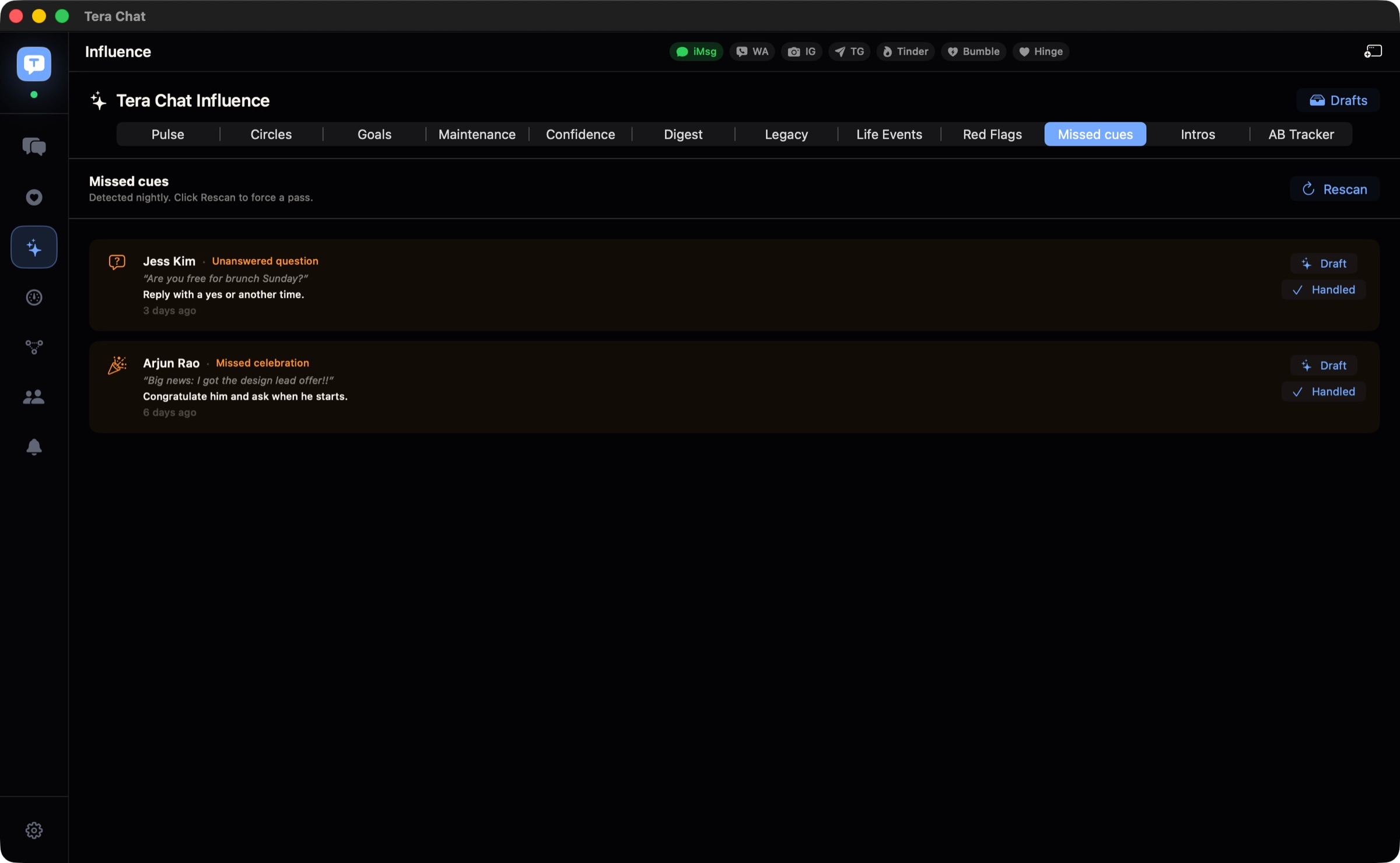
Two honest limits: its missed cues don’t include plans without a date, so keep doing that part by hand, and it’s a Mac app only, with no iPhone version. The detection is one part of its relationship insights, which we explain in health score, missed cues, fading chats and life events. For why replies slip in the first place, read why you might be bad at texting back, and for the wider habit of staying close, our guide to keeping in touch with friends as an adult.
Frequently asked questions
How many unanswered texts is too many?
If you've sent two messages without a reply, pause. One follow-up is reasonable; more than that puts pressure on someone who may be busy, overwhelmed or not wanting to talk.
Is it rude to answer only part of a text?
It's rarely meant that way, but it can feel rude when the part you skipped was a direct question or big news. Read the whole message, and the ones before it, before you reply.
How do I answer a question I missed days ago?
Answer it directly with one line of ownership: Sorry, I missed this. Yes, Sunday works. Then add a next step, such as a time or a question.
What is a missed cue?
Our term for something in a conversation that needed a response and didn't get one: an unanswered question, news you never reacted to, a request for support or an interest you never followed up on. A vague plan that never got a date is a close cousin.
Published . How we write and check our guides. Spotted something out of date? Email hello@terachat.co.