Why am I bad at texting back? A system that doesn't need willpower
Bad at texting back? The five real reasons replies slip, a 15-minute reply debt audit you can do today, and a simple system that keeps you caught up without guilt.
The short answer
- Most people who are bad at texting back do care about the person. The reply slips because they read it at a bad moment, meant to answer later, and nothing brought it back.
- A reply debt audit takes about 15 minutes: list every chat where the last message is theirs, clear the quick replies now, and write one specific next step for the rest.
- Habits beat willpower: a fixed daily reply window, short replies that count as replies, and marking a chat unread the moment you can't answer it.
- The longer you wait, the bigger the reply feels, but research suggests people appreciate hearing from you more than you expect.
- If missed replies come with wider trouble at work or home, ADHD, anxiety or low mood may be part of it, and a doctor is worth talking to.
You’re probably not bad at texting back because you don’t care. Most people who say it read a message at a bad moment, mean to reply properly later, and then nothing brings it back: the chat looks read, new messages bury it, and a reply that would have taken 30 seconds starts to feel like it needs an apology. The fix is a system rather than more willpower: a short audit to clear what you owe now, and a few habits that stop the pile from building up again.
This guide covers the five most common reasons replies slip, a “reply debt” audit with a worksheet you can copy, the habits that keep it near zero, and what to tell friends if you’re simply better in person than on text.
Why am I bad at texting people back?
Usually it’s a mix of five things: when you read messages, what an opened chat looks like, how big a reply feels, how many apps you check, and the guilt that grows each day you wait. None of them is a character flaw, and each one has a practical fix.
1. You read messages at the worst moment
Messages arrive while you’re doing something else, so you read them in the gap between two other tasks and decide to answer “later”. The interruption itself is costly: in a study at Florida State University, phone notifications alone disrupted performance on an attention-demanding task, even when people didn’t touch the phone, by about as much as actively using it. You read the message, your attention snaps back to the task, and “later” has no time attached to it.
2. A read message looks finished
Once you open a chat, the unread badge disappears. Your inbox now treats the conversation as handled, and so does your brain, even though you haven’t replied. That’s a big part of “I saw it and forgot”: nothing on your screen separates “read and answered” from “read and still owed”.
3. The reply feels bigger than it is
Some messages seem to need a proper answer: three questions at once, a long voice note, news that deserves more than “congrats”. So you wait until you have time to do it justice. Psychologists Fuschia Sirois and Timothy Pychyl describe procrastination as putting short-term mood repair ahead of your future self: putting the reply off feels better now and worse later.
4. Too many inboxes
Online adults use an average of 6.75 social platforms a month, according to DataReportal’s Digital 2026 report (GWI data from mid-2025). Messages arrive in iMessage, WhatsApp, Instagram, Telegram and more, each with its own unread list, and no single place shows who is waiting on you.
5. The guilt spiral
Every day you wait, the reply seems to need a bigger apology, so you avoid it a little more. Unfinished intentions also keep nagging at you: in experiments by E. J. Masicampo and Roy Baumeister, unfinished goals caused intrusive thoughts during unrelated tasks. The good news is that the person on the other end is probably less upset than you imagine. Across a series of experiments published in 2023, people underestimated how much others appreciate being reached out to, and the gap was biggest when the message was a surprise.
The reply debt audit: clear what you owe in 15 minutes
Your reply debt is every conversation where the last message is theirs and it needs something from you. The audit gets it out of your head and onto one list, then clears the easy part immediately.
- Set a 15-minute timer. The point is to finish, not to be perfect.
- Make the list. Open each messaging app you use. For every chat from the past month where the last message is theirs, write one line: who, what they said, how long ago.
- Sort each line into one of four buckets:
- Nothing needed: a “haha”, a meme, a thumbs-up. Let it go, or react if you like.
- Two-minute reply: a photo, a quick question, a link.
- Needs a decision: an invitation, a yes-or-no, a plan.
- Needs real time: someone going through something hard, or a long catch-up.
- Clear every two-minute reply now. Don’t polish them.
- For decisions, decide now or set a date. If you can’t decide yet, send a holding reply: “Can I tell you by Thursday?”
- For anything that needs real time, write one specific next step. Not “reply to Sam” but “call Sam Sunday at 11”.
- Start with what matters most: questions with a date attached, news someone shared, and anyone who reached out about something hard.
Writing the plan down is not busywork. In the same Masicampo and Baumeister studies, letting people make a specific plan for an unfinished goal removed the intrusive thoughts it had been causing. Once “call Sam Sunday at 11” is written down, your brain can stop rehearsing it.
Here’s the worksheet. Copy it into Notes or a spreadsheet:
| Person | Their last message | Days waiting | Bucket | Next step | Done |
|---|---|---|---|---|---|
| Priya | “Are you free Saturday?” | 3 | Decision | Check calendar, reply tonight | |
| Dad | Photo of the garden | 5 | Two-minute | “Looks great. Are those the new roses?” | Yes |
| Sam | “Rough week, work is a mess” | 6 | Real time | Call Sunday at 11 | |
| Group chat | A meme | 2 | Nothing needed | React | Yes |
Example rows, made up for this guide.
If the list is long and some replies are weeks overdue, our scripts for when you forgot to text someone back are sorted by how late you are. And when you scan each chat, look past the last message: the unanswered questions and dateless plans hiding in your chats are often further up.
If most of your chats live on a Mac, Tera Chat makes step 2 shorter: its Needs Reply view lists conversations waiting on you from iMessage, WhatsApp, Telegram, Instagram and Tinder in one place, instead of five apps’ worth of unread badges.
A system that doesn’t rely on willpower
Four habits keep reply debt near zero: a fixed time for replies, permission to be brief, never leaving a message read but unhandled, and a short weekly sweep. Each one replaces a decision you’d otherwise have to remember to make.
Habit 1: Give replies a time and a place
“I’ll reply later” fails because later isn’t a time. Psychologists call the fix an implementation intention, an if-then plan that says when and where you’ll act, and a meta-analysis of 94 tests by Peter Gollwitzer and Paschal Sheeran found these plans had a medium-to-large effect on reaching goals. Tie replies to something you already do every day:
- “After I make my morning coffee, I answer anyone waiting.”
- “On the train home, I clear my replies.”
- “Before I open social media in the evening, I reply to one person I owe.”
Ten minutes is enough for most people.
Habit 2: Short replies count
A two-line reply now beats a perfect reply never. When a message deserves more than you have time for, send a holding reply that answers what you can and says when the rest is coming:
- “Saw this and want to answer properly. Can I call you tonight?”
- “Yes to Saturday. I’ll send times tomorrow.”
- “That’s huge news, congratulations. I want to hear everything. Free this weekend?”
If typing feels heavy, a voice note often takes less effort. On a Mac, you can also dictate a text instead of typing it. If wording is what stops you, a first draft can help: Tera Chat drafts replies in your own texting style (your slang, your emoji, your usual length), and you edit and send them yourself.
Habit 3: Never leave a message read but unhandled
Make a rule for the moment you open a message: reply, or mark it unread. On iPhone, swipe right on a conversation in Messages to mark it as unread, and you can filter the list to show only unread chats (as of October 2026). Most other chat apps have a similar option. Telegram goes a step further: a message you schedule in your own Saved Messages chat arrives as a reminder at the time you pick.
Habit 4: A weekly sweep
Once a week, spend ten minutes looking wider than today’s unread messages: who have you not heard from in a while, whose news did you miss, which plan never happened? Put it on your calendar like any other appointment.
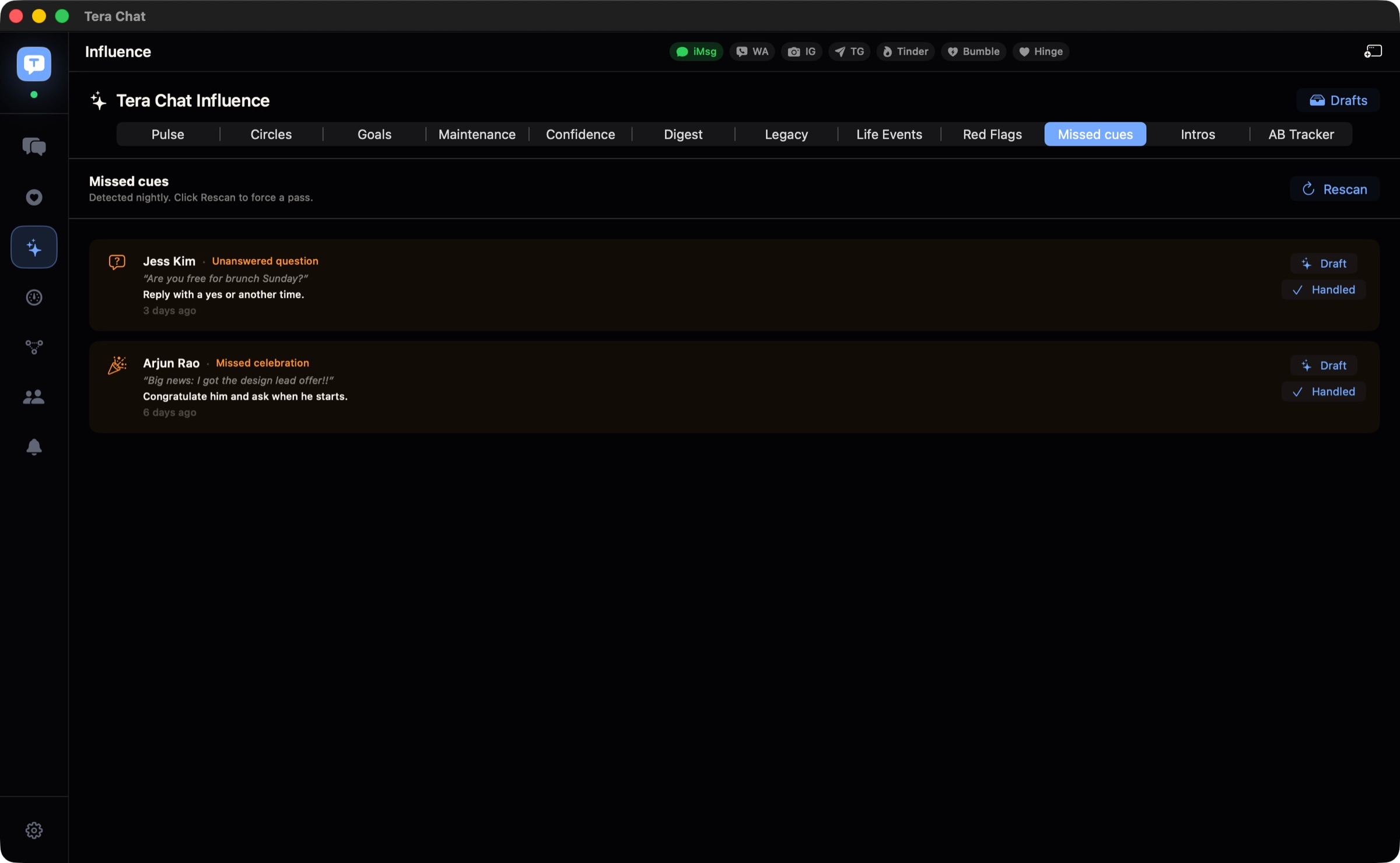
On a Mac, Tera Chat can do the looking for you. A nightly scan on your Mac flags questions you never answered, celebrations you missed and requests for support you didn’t respond to (under Influence → Missed cues), each with a Draft button; the scan itself works without any AI set up. If you do set up AI (your ChatGPT account, your own Claude or Grok API key, or a Tera Chat AI plan), drafts and a weekly digest become available: the digest arrives every Sunday morning with who’s warming up, who’s drifting and who to message. It doesn’t send a notification for every new message, and there’s no iPhone app, so it works best as a desk-time catch-up alongside your phone.
Bad at texting but good in person?
That combination is common, and it isn’t a contradiction. A conversation in person has a beginning and an end, and you get instant feedback. A text conversation never formally ends, so every message opens a new loop you have to remember to close. Some people are simply better at the first kind.
You don’t have to force yourself into being a fast texter. Lean on what works for you: a call, a voice note, a walk. A 2023 study from the University of Kansas found that one quality conversation with a friend in a day improved well-being by the end of that day, and that face-to-face contact was more closely tied to well-being than digital contact.
Then tell people how you work, so silence isn’t misread:
- “Heads up: I’m slow on text, but I read everything. If it’s urgent, call me.”
- “I’m much better on the phone than over text. Can I call you this week instead?”
- “If I go quiet, it’s never about you. Nudge me, I won’t mind.”
When it’s more than a habit
Sometimes missed replies are one sign of something bigger. If you also lose track of tasks, appointments and time in general, our guide to forgetting to text back with ADHD covers systems built for that. If opening messages fills you with dread, read about texting anxiety. And if you’ve stopped replying because everything feels like too much, that can be a sign of low mood. In any of these cases, a GP or doctor is a good first conversation. Nothing in this guide is a diagnosis.
What to do today
- Run the reply debt audit once, and clear every two-minute reply on the list.
- Pick your daily reply window and attach it to something you already do.
- From now on, every message you open gets a reply or gets marked unread.
- Put a ten-minute weekly sweep on your calendar.
Texting back is one part of staying close to people, not the whole of it. For the bigger picture, see our system for keeping in touch with friends as an adult.
Frequently asked questions
Is being bad at texting a red flag in a friend or partner?
Not on its own. Plenty of people who care a lot reply slowly. What matters more is whether they answer the things that need an answer, like plans and big news, and whether they show up in other ways.
Should I tell my friends I'm bad at texting?
Yes, briefly, and pair it with a promise you can keep, such as: I read everything and reply within a couple of days, so call me if it's urgent. Then keep that promise.
How do I stop leaving people on read?
Decide at the moment you open a message: send a one-line reply, or mark the chat unread so it stays visible. Messages on iPhone and most other chat apps let you mark a conversation as unread.
Is it rude to reply weeks later?
A late reply is better than none. Keep the apology to one line, answer what they actually said, and add something that moves the conversation forward.
Can ADHD make you bad at texting back?
It can contribute, because forgetfulness and trouble organizing time are common ADHD symptoms. Only a qualified professional can assess whether ADHD is involved, but external reminders help either way.
Published . How we write and check our guides. Spotted something out of date? Email hello@terachat.co.