How to keep a conversation going on Tinder and Hinge (without interview mode)
How to keep a conversation going on Tinder and Hinge: the statement-plus-question method, hooks, callbacks, annotated example chats and when to suggest a date.
The short answer
- Swap interview mode for statement plus question: react to what they said, add something about you, then ask one specific follow-up.
- Leave hooks in every message. A detail, an opinion or a tiny story gives them something to grab besides your question.
- Callbacks to earlier details read as attention. In Hinge's 2025 Gen Z report, a follow-up to something said earlier was the question daters most often called thoughtful (61%).
- A dating-app chat isn't meant to last forever. Once there's a rhythm and they're asking you questions too, suggest meeting while the conversation still has energy.
To keep a conversation going on Tinder or Hinge, stop firing questions and start trading: react to what they said, add something of your own, then ask one follow-up that’s specific and fun to answer. Bring back details they mentioned earlier, leave small details of your own for them to pick up, and suggest meeting while the chat still has energy instead of waiting for it to run dry.
This guide covers the statement-plus-question method, questions that open a chat up (and the ones that shut it down), callbacks, annotated example chats, and what to do when the other person isn’t putting in the effort. Every example chat here is made up for this guide.
Why do dating app conversations die?
Most dating-app chats die for one of four reasons: one person does all the asking, the messages give nothing to respond to, the questions have one-word answers, or the chat runs on so long without a plan that it loses its point.
The first one has a name: interview mode. It looks like this:
Example chat, made up for this guide (Tinder)
You: What do you do for work?
Jordan: I’m a nurse
You: Nice. Do you like it?
Jordan: Yeah it’s good
You: Cool. What do you do for fun?
No single question here is wrong. The pattern is: every message is a question, none of them say anything about you, and Jordan is doing the work of a job applicant. The answers get shorter because there’s nothing to play off.
The statement + question method
Make every message a small exchange instead of a request. Three parts, in this order:
- React to what they said, specifically. “Nice” and “cool” don’t count.
- Add something about you: an opinion, a detail, a tiny story.
- Ask one question that follows from it.
The same chat, rewritten:
Example chat, made up for this guide (Tinder)
You: What do you do for work?
Jordan: I’m a nurse
You: So you’re the person I’d want next to me in any emergency. I nearly faint at blood tests, which my doctor finds hilarious. What kind of nursing, the calm kind or the chaos kind?
Jordan: Haha chaos. ER nights. Honestly I love it, every shift is different
You: That explains the photo of you asleep in a hammock. Is that how you recover from a run of nights, or is there a better ritual?
Jordan: The hammock is phase two. Phase one is diner pancakes at 8am with the other night nurses. Non-negotiable
What changed:
- “So you’re the person I’d want next to me” reacts to the answer instead of just acknowledging it.
- “I nearly faint at blood tests” adds a detail Jordan can tease you about. That’s a hook.
- “The calm kind or the chaos kind?” is an either-or question with some personality. It’s easier and more fun to answer than “do you like it?”
- The hammock line is a callback to their profile photo, which shows you looked.
- Jordan’s last reply volunteers a story (the pancake ritual) nobody asked for. That’s the sign the chat is working: they’re adding hooks too.
You don’t need all three parts every time. A reaction plus a story (“Same. I once got locked out of my own birthday party”) also works, because it invites a reaction back. The rule to remember: never send two bare questions in a row.
Leave hooks: give them something to grab
A hook is any detail in your message that the other person could ask about. Questions get answers; hooks get questions back, and that’s what makes a chat feel two-sided.
| Flat message | Message with hooks |
|---|---|
| “I had a good weekend.” | “Spent Saturday building a bookshelf. It’s now a very confident leaning tower.” |
| “I like hiking.” | “I’m a hiker in the ‘walk four hours for one sandwich at the top’ sense.” |
| “Work was busy.” | “Work was busy. The clicker died mid-presentation, so I did the whole thing by saying ‘next slide’ to my coworker.” |
| “I’m from Chicago.” | “I’m from Chicago, so I have opinions about hot dogs that I will share if provoked.” |
Each version on the right gives them at least two things to respond to. You’re not performing. You’re including the specific bit you’d tell a friend.
Ask questions that open up, not close down
Closed questions can be answered in one word; open ones invite a story or an opinion. Closed questions are fine for quick facts, but if every question ends in “yes” or “no”, the chat will stall.
| Closes it down | Opens it up |
|---|---|
| “Do you like your job?” | “What’s the best and worst part of your job this week?” |
| “Do you travel a lot?” | “What’s a trip that went wrong but you’d do again?” |
| “Are you into music?” | “What song do you put on to win over a room?” |
| “Did you have a good weekend?” | “What was the highlight of your weekend, and was it planned?” |
| “Do you cook?” | “What’s the one dish people ask you to make?” |
Two habits help. Ask about specifics they already mentioned (their prompt, a photo, a line from their last message) rather than general topics. And when the chat needs energy, use either-or questions with a bit of stakes: “Movie snacks, sweet or salty? And is mixing them a crime?” When you’d like the chat to turn a little flirty, our guide on how to flirt over text has before-and-after rewrites.
Hinge’s research points the same way. In its 2025 Gen Z D.A.T.E. Report (about 30,000 daters), 85% of daters said they’re more likely to want a second date when they’re asked thoughtful questions, and the kind of question most often seen as thoughtful was a follow-up to something said earlier (61%). The report is about dates rather than chats, but the habit carries straight over.
Use callbacks
A callback picks up something from earlier in the chat, or from their profile, and brings it back. It’s the clearest sign you’re paying attention and the easiest way to restart a thread that’s gone flat.
- “Wait, you never told me whether the pancakes or the hammock wins.”
- “Update on the leaning bookshelf: it fell. You called it.”
- “Did your sister’s wedding speech go okay? You said you were writing it on the train.”
- “I tried the noodle place you mentioned. You’ve ruined all other noodles for me.”
Callbacks land best a day or two after the original mention, and they set up a plan. “I tried the noodle place” is one step away from “Want to go back with me and you pick the order this time?”
A full annotated chat: from comment to plan
Example chat, made up for this guide (Hinge, over two days)
Priya’s prompt: “I go crazy for: a good market. Food, flowers, vintage, I’m there.”
You (comment on the prompt): What’s the best thing you’ve ever found at a market?
Priya: Ooh. A tiny cactus that’s somehow still alive four years later. You?
You: Respect to the cactus. Mine is a $3 record that turned out to be signed. I’m still unreasonably proud. Are you a food-first or flowers-first market person?
Priya: Food first, obviously. Flowers are dessert
You: Flowers as dessert is a strong philosophy. What’s the one market food you’d wait in line 20 minutes for?
Priya: The dumplings at the Saturday market by the river. The line is part of the experience
(the next day)
You: I’ve been thinking about those dumplings. I’ve never been to that market, which feels like a gap in my education. Want to go Saturday morning? You can tell me what to order.
What’s happening:
- The comment asks about her prompt with a question that has a story for an answer. Hinge’s Convo Starters announcement says likes sent with a comment are twice as likely to lead to a date.
- Each of your messages reacts, adds a small detail (the signed record) and asks one thing.
- The either-or question is light and gives her room to be funny, which she takes (“flowers are dessert”).
- The next-day message is a callback that turns straight into a specific plan built on something she loves. That’s the whole arc in seven messages.
For more ways to start chats like this one, see our first message examples sorted by what’s in their profile.
Topics that keep a chat going
When you’re stuck, these threads work because they invite stories and opinions, not facts:
- Rankings: “Rank these: brunch, late-night food, a picnic.”
- Small-stakes debates: “Is a hot dog a sandwich? Your answer decides a lot.”
- Story prompts: “What’s the most ‘only me’ thing that happened to you this month?”
- Plans and wishes: “What’s on your list for this fall?”
- Their expertise: “You climb, right? What do beginners always get wrong?”
- Tiny confessions: “Confession: I’ve never finished a podcast episode. What’s yours?”
- Hypotheticals about them: “If your dog could talk for one minute, what would he complain about?”
Use them as fuel, not a script: one per lull, and always add your own answer.
How long should you keep the chat going?
Not forever. The point of a dating-app conversation is to find out whether you want to meet. Once you’ve had a few good back-and-forths and they’re asking you questions too, suggest a specific plan. Chats that drift on for weeks without one usually fade before anyone meets.
The conversation does matter, sometimes more than first impressions. In Match’s 2026 Singles in America study (about 5,000 US singles), great conversation was the top reason people became interested in someone they weren’t initially attracted to (47%). Use that momentum: how to ask someone out over text has the exact wording.
What if they aren’t putting in any effort?
You can make a chat easier to answer, but you can’t carry it alone. If you’ve used statement-plus-question two or three times and still get “haha” or “yeah”, see how to respond to dry texts. If they’ve gone silent, what to send when a match stopped replying covers the one-follow-up rule.
Can AI help you keep a conversation going?
It can help you get unstuck, as long as the message you send is still yours. Keeping a conversation going was one of the top ways singles thought AI could help with dating: 27% of US singles aged 18 to 39 chose it in a Match Group survey published in June 2026. Hinge’s AI dating guide puts the line well: treat AI “as your wingman, not your ghostwriter.”
If you’re on a Mac, Tera Chat puts your Tinder matches in the same inbox as iMessage, WhatsApp, Telegram and Instagram. It flags questions you never answered and conversations that are going quiet, so a good chat doesn’t fade just because you forgot to reply. When you’re stuck, it drafts a reply in your texting style (dating drafts need a Tera Chat AI plan or your own ChatGPT account through Codex), and you rewrite it and send it yourself. For example:
- Draft: “Food first is the right answer. What’s your go-to order at the market?”
- Your edit: “Flowers as dessert is a strong philosophy. What’s the one market food you’d wait in line 20 minutes for?”
The draft gave you the direction; your edit added the joke only you would make.
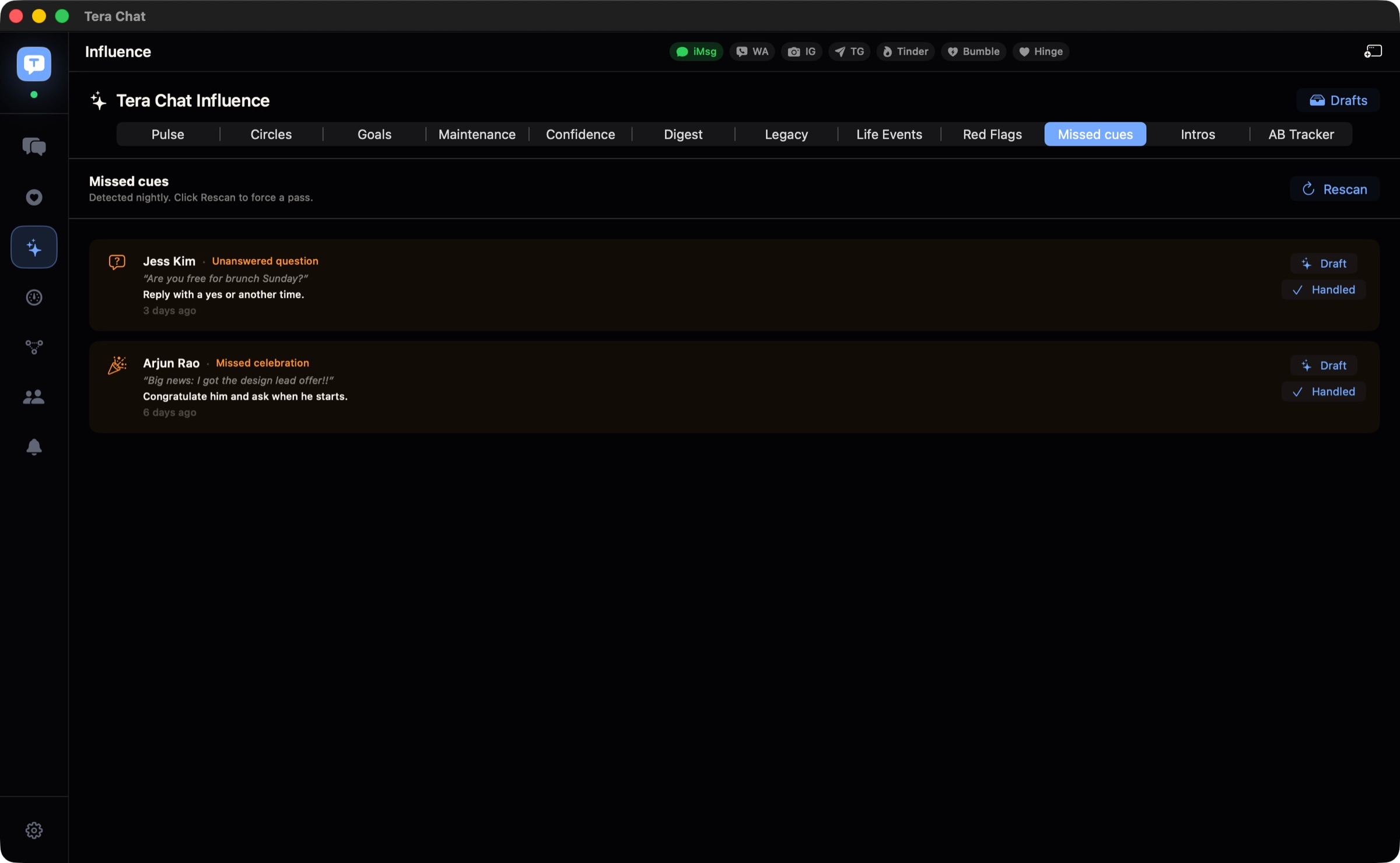
One honest caveat: Tera Chat connects to your Tinder account (Hinge is a read-only beta), so it’s the kind of third-party tool that Tinder’s and Hinge’s terms restrict, AI included. Read what Tinder and Hinge’s rules say about AI before you connect a dating account. Tera Chat isn’t affiliated with Tinder, Hinge or Match Group.
The short version
- React, add, ask: one question per message, with something of yours attached.
- Leave hooks, and bring details back with callbacks.
- Swap yes-or-no questions for ones with a story in them.
- Suggest a plan once there’s a rhythm.
- If they won’t meet you halfway, it isn’t a technique problem, and you can move on.
Frequently asked questions
How many questions should I ask in one dating app message?
One is usually right. Two can work if they're linked, but three or more reads like a form, and people tend to answer only the easiest one.
What should I talk about on Tinder after the opener?
Whatever their reply gives you. Pick the most specific detail in it, react to it, share your own version, and ask about the part they seem to care about. Jobs, hometowns and weekends are fine topics if you ask about the interesting part rather than the facts.
How long should you text on a dating app before meeting?
There's no set number of days or messages. A good signal is when the chat flows both ways and they're curious about you; that's the moment to suggest something specific and low-key, rather than letting the chat run on for weeks.
Is it bad to send long messages on Hinge or Tinder?
Roughly match their length. Two to four sentences is plenty for most messages. A wall of text early on is hard to answer, and a one-liner every time gives them nothing to work with.
What if I run out of things to say?
Go back to something they mentioned earlier and ask how it went, or offer a light either-or question with your own answer attached. If you still have nothing, that's often the moment to suggest meeting instead of forcing more chat.
Published . How we write and check our guides. Spotted something out of date? Email hello@terachat.co.