First message on Tinder or Hinge: 50 examples sorted by their profile
The best first message on Tinder or Hinge uses one detail from their profile. 50 examples sorted by what's in it (pets, travel, food, music, work), plus Hinge data.
The short answer
- The best first message on a dating app picks one specific detail from the match's profile, adds a little of you, and ends with an easy question only they can answer.
- Hinge reports that likes sent with a comment are twice as likely to lead to a date, and that 72% of daters are more likely to consider someone whose like includes a message.
- Keep it to one or two sentences: a study of online daters found little payoff for writing longer first messages.
- Skip 'hey' on its own, pickup lines and comments about bodies; a message you could send to every match works on almost none of them.
- If you use AI for ideas, write the final words yourself: Hinge's terms ban content you didn't write, and Tinder's and Hinge's terms restrict third-party tools that connect to the app.
The best first message on a dating app picks one specific thing from the other person’s profile and asks something only they can answer. “Is the lemon tree in your second photo yours, and does it actually produce lemons?” beats “hey” or a pickup line because it proves you read their profile and hands them an easy, fun thing to reply to. Hinge’s own data points the same way: likes sent with a comment are twice as likely to lead to a date, and 72% of daters say they’re more likely to consider someone when a like includes a message.
Below are 50 first messages sorted by what’s actually in the profile: pets, travel, food, sport, music, books and TV, work, a funny line, a strong opinion, a Hinge prompt, something you share, and almost nothing at all. Each has a short note on why it works. After that: how the first message differs on Tinder and Hinge, a full example chat, what to skip, and how to use AI for ideas without sounding like a bot. Every profile and chat on this page is made up for this guide.
What makes a good first message on a dating app?
A good first message is specific, short and easy to answer. Most good openers have three parts:
- One detail from their profile: a photo, a line in their bio, a prompt answer, an interest.
- A small reaction that shows a bit of you: an opinion, a guess, a joke, a “me too”.
- An easy question they can answer in a sentence.
Not every message needs all three, but the detail is the part you can’t skip. It’s what makes the message impossible to copy and paste, and it’s what the other person is looking for when they decide whether to answer.
Three findings back this up:
- Words give you more to work with than photos. On Hinge, “likes on text prompts were 47% more likely to lead to a date than likes on photos” in 2024 (Hinge, January 2025).
- Longer isn’t better. A study of first messages on a dating site in four US cities found people write much longer messages to more desirable partners, but the payoff was small, and the authors concluded the extra effort “may be wasted” (Bruch and Newman, Science Advances, 2018; the data is from January 2014). So put the effort into relevance, not length.
- One-word openers bore people. Hinge said in 2022 that half of daters feel bored when they receive a one-word opener (Hinge).
Quick fixes for generic openers
| Generic opener | Specific version | What changed |
|---|---|---|
| “Hey, how’s your week going?” | “Your bio says you’re ‘between hobbies’. Which one got dropped most recently?” | It answers a line they wrote |
| “You’re gorgeous” | “Your laugh in the wedding photo looks like someone just said something ridiculous. What was it?” | It notices a moment, not their body |
| “What do you do for fun?” | “Climbing gym photo: are you a ‘same route for weeks’ person or a ‘try everything once’ person?” | The question is about them, not anyone |
| “Nice dog” | “Your dog looks like he has strong opinions about the mail carrier. Accurate?” | A playful guess is easy to answer |
| “Where was that photo?” | “That beach in photo four: tell-everyone spot or keep-it-secret spot?” | A choice is easier than an open question |
50 first message examples, sorted by what’s in their profile
Find the section that matches what you see. Treat each message as a starting point and change the words until they sound like you. Where a message mentions something about “you” (your family, your cooking), swap in a detail that’s true.
If they have a pet
- A grey cat sitting on a laptop keyboard: “Does the cat help with your work, or mostly with the typos?” A light joke about that exact photo, and everyone with a cat has a story ready.
- Bio: “Dog mom to a three-legged rescue named Biscuit”: “Biscuit sounds like a legend. How did she get her name?” Using the dog’s name shows you read the bio, and name stories are easy to tell.
- A dog mid-sprint on a beach: “On a scale from ‘calm’ to ‘this exact photo’, how is your dog at home?” A scale takes two seconds to answer and usually comes back with a story.
- “Dogs” in their interests but no dog in the photos: “Dogs are in your interests but not your photos. Dog owner, or very committed dog admirer?” Spots a small gap and turns it into an either/or.
- A photo holding a rabbit: “I’ve never known anyone with a rabbit. What’s the thing nobody tells you about having one?” Honest curiosity lets them be the expert.
If they travel
- A photo at a ramen counter with a hand-written menu: “Ramen counter in photo two: best bowl you’ve ever had, or is there a better one you’re keeping to yourself?” A food question is easier to answer than “how was Japan?”
- Bio: “31 countries, still can’t pack light”: “31 countries and still overpacking is reassuring. What’s the most useless thing you’ve carried across a border?” Picks up their own joke and asks for a story.
- A photo outside a mountain hut: “That mountain hut photo looks earned. Did you hike up, or is there a cable car you’re not mentioning?” A playful accusation people enjoy answering.
- Bio: “Next trip: Mexico City”: “Mexico City next. Is there a plan, or is it an ‘eat everything and figure it out’ trip?” Upcoming trips are fun to talk about and give you something to ask about later.
- Photos on three continents: “If you could go back to one of the places in your photos tomorrow, which one?” One choice, not a request for their life story.
If food is their thing
- A lopsided homemade cake: “The cake in photo three has character. Recipe or freestyle?” Teasing the cake, not the person, keeps it warm.
- Bio: “Will judge you by your hot sauce shelf”: “How many hot sauces does a shelf need to pass? Asking for my two.” Plays along with their line and admits something about you.
- A photo at a sushi counter: “Are you an ‘order the omakase’ person or a ‘same three rolls every time’ person?” Either answer tells you something real.
- Bio: “Working my way through every taco spot in the city”: “Where are you on the taco list, and which one’s winning so far?” Their project, their ranking, and a natural reason to suggest a place later.
- Bio: “I make a mean lasagna”: “‘Mean lasagna’ is a bold claim. What’s the secret, or is that need-to-know?” Takes the brag seriously, which is flattering and funny.
If they’re into fitness or sport
- A photo crossing a half-marathon finish line: “Congrats on the race in photo four. What were you thinking about at mile 11?” A specific moment beats “you must be fit”.
- Bio: “Rec league volleyball, mostly for the post-game nachos”: “What’s the honest volleyball-to-nachos ratio?” Their joke, one short question.
- A bouldering photo: “What’s the problem that’s been beating you lately?” Climbers call boulder routes “problems”, so it shows you know the world (only use it if you do).
- A local soccer team’s jersey: “I see the jersey. Are we celebrating this season or coping?” Works whether the team is winning or losing.
- Bio: “6am yoga, somehow”: “Were you always a morning person, or did the yoga do this to you?” Picks up the “somehow” they wrote.
If they’re into music
- A Bill Withers song on their profile: “Bill Withers on your profile. Sunday-morning pick or every-day pick?” Shows you noticed the song and asks how it fits their life.
- A photo in a festival crowd: “Festival photo: which set would you go back in time to see again?” A favorite-memory question, easy and happy.
- Bio: “Plays bass, badly, in a band nobody’s heard of”: “What’s the band called? I’d like to say I was early.” Supportive and funny at the same time.
- Bio: “Karaoke song: Total Eclipse of the Heart”: “Bold karaoke pick. Do you commit to the whole thing or bail during the quiet part?” Respects the choice and asks for the story.
If they mention books, films or TV
- A photo reading on a train: “What’s the book in photo two? The cover looks like it has a twist.” People who read love being asked what they’re reading.
- Bio: “Will rewatch The Office forever”: “Which season are you on in the current rewatch?” Assumes there’s a rewatch going, which there always is.
- Bio: “Horror movies only”: “What’s a horror film that actually scared you, not just made you jump?” Asks for taste, not a list.
- Bio: “Book club dropout”: “What book made you quit book club? I need to know the villain.” Turns a throwaway line into a story.
If they mention their job or studies
- Bio: “ER nurse”: “What’s one thing TV gets completely wrong about ER shifts?” Asks about their expertise and avoids the tired lines people in caring jobs get every day.
- Bio: “Architect”: “Is there a building in this city you secretly can’t stand?” An opinion question they’re qualified to answer.
- Bio: “PhD in marine biology”: “What’s the most underrated sea creature? I need a new favorite.” Lets them be enthusiastic.
- Bio: “Third-grade teacher”: “What’s the best excuse a third grader has ever given you?” Every teacher has one, and it’s always good.
- Bio: “Chef”: “Do chefs actually cook at home, or is it cereal after a shift?” A real question with a funny option.
If their bio has a funny or strange line
- “Looking for someone to split dessert with (I will take more than half)”: “What split are you proposing? I’d like to negotiate before this goes any further.” Plays the game they started.
- “Will let you win at Mario Kart (lie)”: “Which track are you unbeatable on? I’d like to avoid it.” Accepts the challenge in one line.
- “Professional overthinker”: “What did you overthink today? I’ll go second.” Offers to share too, which makes it feel even.
- “I have strong opinions about fonts”: “Okay, I’ll bite. Which font should be banned?” They wrote that line hoping someone would ask.
If they state a strong opinion
- “Breakfast for dinner is the best meal of the week”: “Agreed in principle. Pancakes or eggs, though? This decides everything.” Agreeing first, then a tiny debate.
- “Beach vacations are boring”: “Beaches being boring is a brave stance. What’s your perfect trip instead?” Pushes back gently and asks what they do like.
- “Cats > dogs”: “Cats over dogs is fighting words in my family. Defend it in one sentence.” Mock-serious, with a limit that keeps the reply easy.
If it’s a Hinge prompt
On Hinge, your first message usually goes out with a like on one prompt, so react to their answer rather than the prompt itself. There’s more on this in Hinge comments that get replies.
- “Typical Sunday: long run, then undoing it all with a bacon sandwich”: “How far do you have to run to earn the sandwich? I need the exchange rate.” Goes straight for the funniest part.
- “I’m looking for: someone who’ll come to my friend’s terrible improv shows with me”: “How terrible are we talking? I’ve sat through some rough ones and survived.” Shows you’re up for it without overpromising.
- “My most irrational fear: geese”: “Geese are a completely rational fear. What happened?” Siding with them is warm, and there’s always a goose story.
- “Together, we could: build a blanket fort and watch every Studio Ghibli film”: “Every Ghibli film in one fort is ambitious. What’s the running order? I have notes.” Accepts the plan and adds a playful twist.
- “Two truths and a lie: I’ve been on TV for a pie contest / I can juggle / I’ve never seen Star Wars”: “The lie is juggling. Nobody who can juggle keeps quiet about it this long.” A guess with a reason is more fun than just “the second one”.
If you have something in common
- Bio: “Originally from Cleveland” (and so are you): “Another Clevelander. What do you miss most, and what don’t you miss at all?” Shared ground plus a question with two sides.
- “Board games” in their interests: “Are you a ‘learn a two-hour game for fun’ person or an ‘Uno is plenty’ person?” Says you’re into it too without listing your collection.
If there’s almost nothing to go on
- No bio, one photo at a wedding: “Your wedding-guest photo has strong ‘last one on the dance floor’ energy. Accurate?” Reads the mood of the photo, not their looks.
- No bio, interests: coffee, hiking, podcasts: “Coffee, hiking and podcasts is a very good Saturday. Which podcast would you recommend to a stranger?” Ties three tags into one easy ask.
- One selfie and nothing else: “You’ve kept your profile a mystery, so I’ll guess: you order fries for the table before the drinks arrive. How close am I?” A harmless guess invites them to correct you.
For a full method when a profile is nearly empty, see openers for profiles with no bio, and for longer Tinder-specific examples with likely replies, see Tinder openers for every kind of profile.
How first messages work on Tinder vs Hinge
The advice above works on both apps, but when you write the first message is different.
| Tinder | Hinge | |
|---|---|---|
| When you write it | After you’ve both swiped right and matched | Usually with your like, before you match |
| What you react to | Their photos, bio and interests | One specific photo or prompt answer you chose to like |
| Who sends first | Either of you, once you’ve matched | The person sending the like can add a comment; the other person decides whether to match |
On Tinder, once you match, either of you can message first, so if you’re interested, don’t wait. On Hinge, likes you receive appear in your Likes You tab (Hinge), where you choose whether to match with each person. If someone liked you first, the first message in the chat is yours: here’s how to respond to a like on Hinge.
Example chat: from first message to a plan
Example chat, made up for this guide. A Tinder match, Maya. Her bio: “Learning to make dumplings from my grandma over FaceTime. Results: mixed.” Her third photo is a tray of slightly lopsided dumplings.
You: The dumpling tray in photo three looks like a win to me. What does your grandma say about the folding?
Maya: she says they look like “sad little purses” lol. they taste fine though
You: Sad little purses is a very specific review. Mine would be worse, I’ve only ever made them from a frozen bag. What filling are you working on?
Maya: pork and chive. next week I’m trying shrimp, which she says I’m not ready for
You: The shrimp level-up. There’s a dumpling place by the park I keep meaning to try, and I’d like an expert opinion. Want to go Thursday after work?
What each message did:
- First message: one detail (photo three) and an easy question about someone she clearly loves.
- Second: laughed along with her joke, added one honest fact about you, asked one question.
- Third: used what she’d just said (the shrimp) and turned it into a specific plan with a day attached.
Three messages is quick for an ask; it worked here because she was writing back with energy. If replies are short, spend a few more messages finding common ground first. How to keep a conversation going on dating apps covers that middle stretch.
First messages to skip
- “Hey” on its own. Not rude, but it hands them all the work. If you send it, put a real question in the same message.
- Pickup lines that could go to anyone. If you could send it unchanged to every match, it says nothing about this one.
- Comments about their body. Compliment a choice they made (the photo, the joke, the hobby), not how they look.
- The interview. Three questions in one message feels like a form. Pick the best one.
- Negative openers. “Your bio is pretty empty” or complaints about the app start the chat on a low note.
- Asking for their number, Instagram or Snapchat straight away. Let the conversation earn it. Watch for this in the other direction too: the FTC lists a new match who soon wants to “message you off the platform”, and later asks for money, as a common romance-scam pattern (FTC).
When to send it, and what if they don’t reply
Send it soon. Hinge says “your best chance at getting a response is within 24 hours of matching” (Hinge, December 2025), and its 2023 data found that matches whose first message got a response within 24 hours were 72% more likely to result in a date (Hinge, May 2024). Our guide to Dating Sunday has more on timing.
If they don’t reply, send one light follow-up a few days later that brings something new, for example: “Still thinking about your hot sauce shelf. Did it grow this week?” If that gets nothing, let it go and put your energy into the matches who write back.
Using AI for a first message without sounding like a bot
AI can help you get unstuck, but the message should be yours. That’s also where the dating apps draw the line:
- Hinge’s own AI feature, Convo Starters, shows three tips about a specific photo or prompt when you send a like, and Hinge says its AI tools “do not provide pre-written language for daters to copy and paste” (Hinge).
- Hinge’s Logan Ury describes AI as a wingman that checks your ideas, not a ghostwriter that writes for you (Hinge, March 2026).
- Hinge’s terms ban content that “was not written by you or was automatically generated” unless Hinge authorized it (Hinge Terms, §2d item 11). Tinder’s and Hinge’s terms both ban third-party tools that directly interact with the app without written consent, AI included (Tinder Terms and Hinge Terms, §2c item 22).
So use AI for ideas (which detail is most interesting, what to ask about it), then write the line yourself. Here’s the difference an edit makes:
- AI draft (example): “Biscuit sounds like an absolute legend. I’d love to hear the story behind her name and how she’s adjusting to life on three legs.”
- What you’d actually send: “ok Biscuit is clearly the main character here. how’d she get her name?”
The draft is polite and complete, and it reads like a cover letter. The edit is shorter, drops the question about her leg (a heavier topic for a first message), and sounds like a person texting.
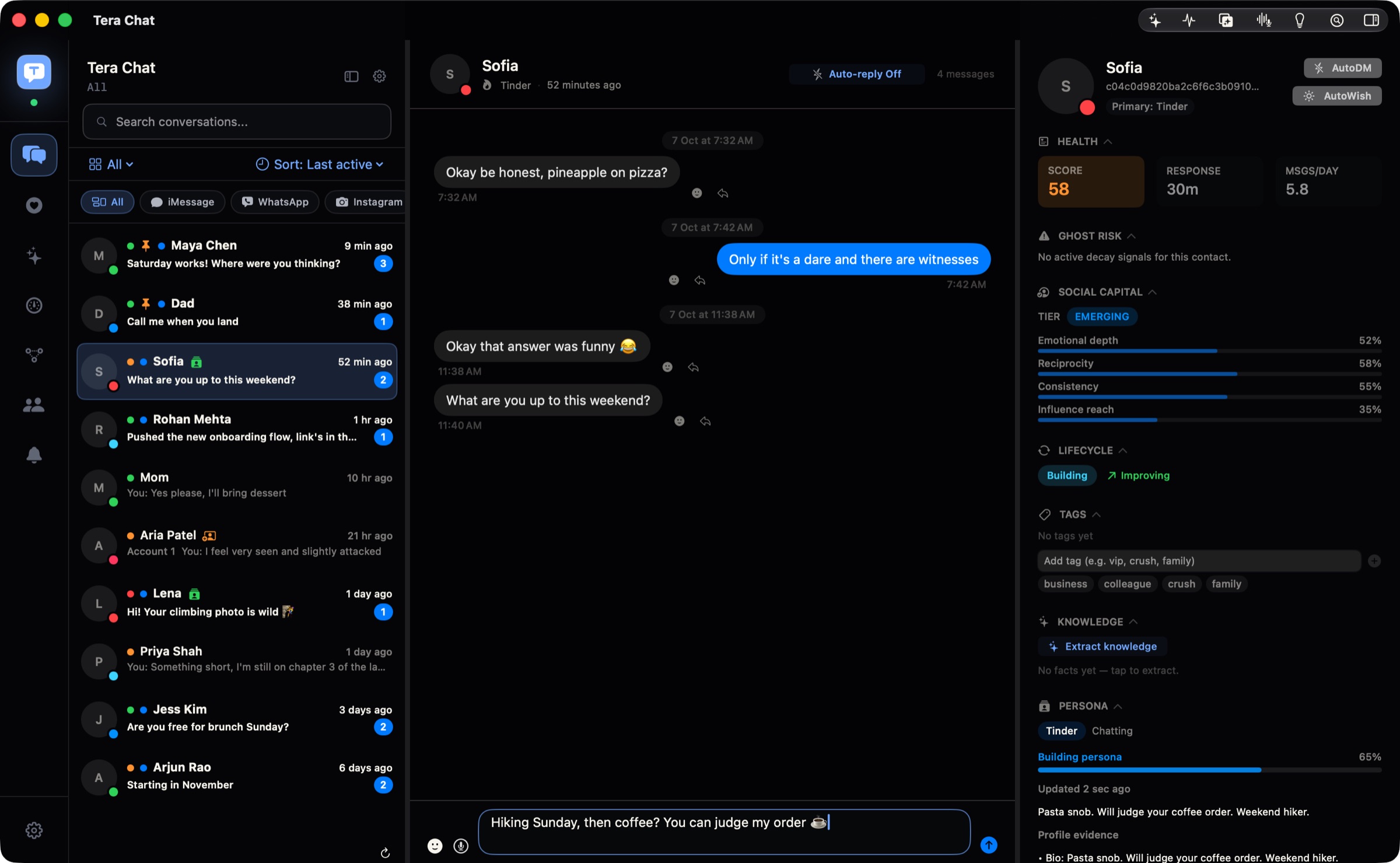
That’s how Tera Chat handles dating. It’s a free Mac app (Apple silicon, macOS 15 or later) that puts your Tinder matches next to iMessage, WhatsApp, Telegram and Instagram, with a New matches rail showing the people who haven’t heard from you yet. With a Tera Chat AI plan (from $9.99 a month as of October 2026, cancel anytime) or your own ChatGPT account through Codex, it drafts openers from each match’s own bio and prompts. Preparing openers doesn’t send anything: you review each one, rewrite it in your words and send it yourself. Tera Chat connects to your Tinder account (Hinge is a read-only beta), so it’s the kind of third-party tool those terms cover; read what Tinder’s and Hinge’s rules say about AI before you decide. Tera Chat isn’t affiliated with Tinder, Hinge or Match Group.
The short version
- Pick one detail from their profile, react to it, ask one easy question.
- One or two sentences. No pickup lines, no body comments, no “hey” on its own.
- Send it within a day of matching. One follow-up if they go quiet, then let it go.
- On Hinge, comment on a prompt answer rather than just liking.
- If AI helps you find the idea, the words you send should still be yours.
Frequently asked questions
What is a good first message on Tinder?
One that only works for that person: mention something specific from their photos or bio and ask a question about it, such as 'Is the lemon tree in your second photo yours, and does it actually produce lemons?' Keep it to one or two sentences.
Is 'hey' a bad first message?
It isn't rude, but it gives the other person nothing to answer, so all the work of starting a conversation lands on them. If you send it, add one specific question in the same message.
Should a first message be a question?
Usually, because a question gives them an easy way in. A playful guess or opinion about something in their profile works too, as long as it invites an answer.
Who should send the first message on Tinder?
Either person can message first once you've matched on Tinder. If you're interested, there's no reason to wait for them.
How soon should I message after matching?
Within a day if you can. Hinge says your best chance of getting a response is within 24 hours of matching.
What if they don't reply to my first message?
Send one light follow-up a few days later that brings something new, not 'hello?'. If that gets nothing, let it go and spend your energy on the matches who write back.
Published . How we write and check our guides. Spotted something out of date? Email hello@terachat.co.