How to remember details about people (without being creepy)
An app to remember details about people helps, but the method matters more: what to note, when to review it, and where attentive ends and creepy begins.
The short answer
- Write down what someone tells you within a day: what's coming up for them, what they're dealing with and what they're excited about, with a date.
- Keep one place per person, glance at it before you next talk, and use it to ask a follow-up question; research finds people who ask more follow-up questions are better liked.
- Try to recall what they told you before you open your notes: testing your memory makes it stick better than rereading.
- The line between attentive and creepy: keep only what people told you directly, never what you dug up about them, and use details to ask rather than to show off.
To remember details about people, stop relying on memory. Write down what someone tells you within a day (what’s coming up for them, what they’re dealing with, what they’re excited about), keep it in one place per person, glance at it before you next talk, and then ask a follow-up question. Stay on the right side of the line by keeping only what people told you directly, never what you dug up about them.
This guide covers what’s worth remembering, a four-step method, where to keep notes (including apps), and clear rules for staying attentive rather than creepy.
Why remembering details matters
Remembering what someone told you is how you show you were listening, and it’s what makes good follow-up questions possible days or weeks later.
The research on follow-up questions is encouraging. In three studies of live conversations, Karen Huang and colleagues at Harvard found that people who asked more questions, particularly follow-up questions, were better liked by their conversation partners, because they came across as more responsive: listening, understanding and caring. In speed-dating data, people who asked more follow-up questions got more agreements to a second date. (An independent audit of the paper in 2025 found minor reporting errors and confirmed its conclusions.)
Remembering also makes reaching out easier. “How did the interview go?” is a far easier message to send, and to answer, than “hey, how are you?”. And people tend to appreciate being contacted more than we expect: preregistered experiments by Peggy Liu and colleagues found that people consistently underestimate how much others value a check-in.
What’s worth remembering
Note the things that will still matter next time you talk, and the things that would be hurtful to forget. Skip trivia.
| What to note | Examples | Why it’s worth it |
|---|---|---|
| Upcoming events, with a date | A job interview on Thursday, a surgery, an exam, moving day, a trip | Gives you a natural reason to follow up afterwards |
| Ongoing situations | A job hunt, a parent’s illness, a renovation, a breakup | Lets you ask how it’s going instead of making them re-explain |
| The people in their life | A partner’s name, kids’ names and ages, a dog called Biscuit | Forgetting these is hard to hide |
| Preferences and needs | Vegetarian, allergic to nuts, hates surprise parties | Saves awkwardness when you plan or gift |
| Projects and wins | Training for a marathon, launching a small business | Asking about progress shows you’ve been paying attention |
| Things they recommended | A book, a show, a restaurant | “I finally watched it” is an easy, warm message |
What not to note: gossip about them from other people, things they told you in confidence (or keep those vaguer), and judgments (“a bit much”) you’d be embarrassed for them to read.
The method: capture, keep, review, use
Four small steps, a few minutes each, are enough.
1. Capture within a day
After a conversation, answer three questions in a line or two each, with the date:
- What’s coming up for them? (“Interview at the design studio, Thu 9 Oct.”)
- What are they dealing with? (“Mum’s knee surgery went OK, rehab is slow.”)
- What lit them up? (“Pottery class, already made a lopsided mug.”)
Do it on the walk home or in the car, and dictate it if typing is a hassle. Don’t take notes mid-conversation at a dinner; it changes the conversation.
2. Keep one place per person
A note per person beats a pile of scattered notes, because you’ll actually find it before the next conversation. The notes field on the person’s contact card is the simplest choice: it’s already on your phone and Mac and it travels with their number.
3. Review before you talk, and try to recall first
Before a call, a dinner or a birthday message, spend 30 seconds trying to remember what they told you last time, then open the note to check. This uses retrieval practice: classroom research by Henry Roediger and colleagues found that low-stakes quizzing improved later exam results more than seeing the same material again. Over time, you’ll need the notes less.
4. Use it: ask the follow-up
The point of remembering is the question it lets you ask. Compare:
| Generic | With a remembered detail |
|---|---|
| “Hey, how are you?” | “How’s the new flat? Did the landlord ever fix the boiler?” |
| “Happy birthday.” | “Happy birthday. Hope the pottery class is still going and the mugs are getting less lopsided.” |
| “Long time no see.” | “How did your mum’s rehab go in the end? I’ve thought about her a few times.” |
| “How was your week?” | “Was Thursday the interview? Tell me everything.” |
For dated events, add a reminder: “Thursday 7 pm: ask Sam how the interview went.” That one habit turns a remembered detail into a well-timed message.
Where to keep notes about people
Any of these works if you use it consistently. Tera Chat is our app; we’ve tried to be fair, and we say where others are the better pick.
| Tool | How details get in | Cost (October 2026) | Where the notes live | Best for |
|---|---|---|---|---|
| Contacts notes field (iPhone, Mac, Android) | You type them | Free | Your phone’s contacts account | Most people |
| Notes app or a document | You type them | Free | Wherever your notes sync | People who like freeform notes |
| Spreadsheet | You type them | Free | Wherever the file is stored | People who like sorting and columns |
| Dex | You type them, plus imports from connected accounts | From $12/month billed yearly (pricing) | Dex’s cloud service | Large professional networks |
| Mesh | You type them, plus email, meetings and connected accounts | Free up to 1,000 contacts, card required (pricing) | Mesh’s cloud service | Large networks on a budget |
| Tera Chat (Mac) | Learned from your chats in iMessage, WhatsApp, Telegram, Instagram and Tinder, once AI is set up | App free; AI via your own account or from $9.99/month | Messages stay on your Mac; learned facts sync only through your own iCloud | Friends you mostly text |
Personal CRMs are the stronger pick if your relationships live in email, meetings and LinkedIn; we compare them in personal CRMs for friends.
Tera Chat takes a different approach: instead of a notebook you fill in, it works from your conversations. Its missed cues, which work without any AI set up, flag questions you never answered, celebrations you missed, support requests you didn’t respond to and interests you never followed up on. Once AI is set up, each contact also gets a profile with things worth remembering about them, and Ask about this chat answers questions like “what restaurant did she mention?” from the recent messages and what it has learned.
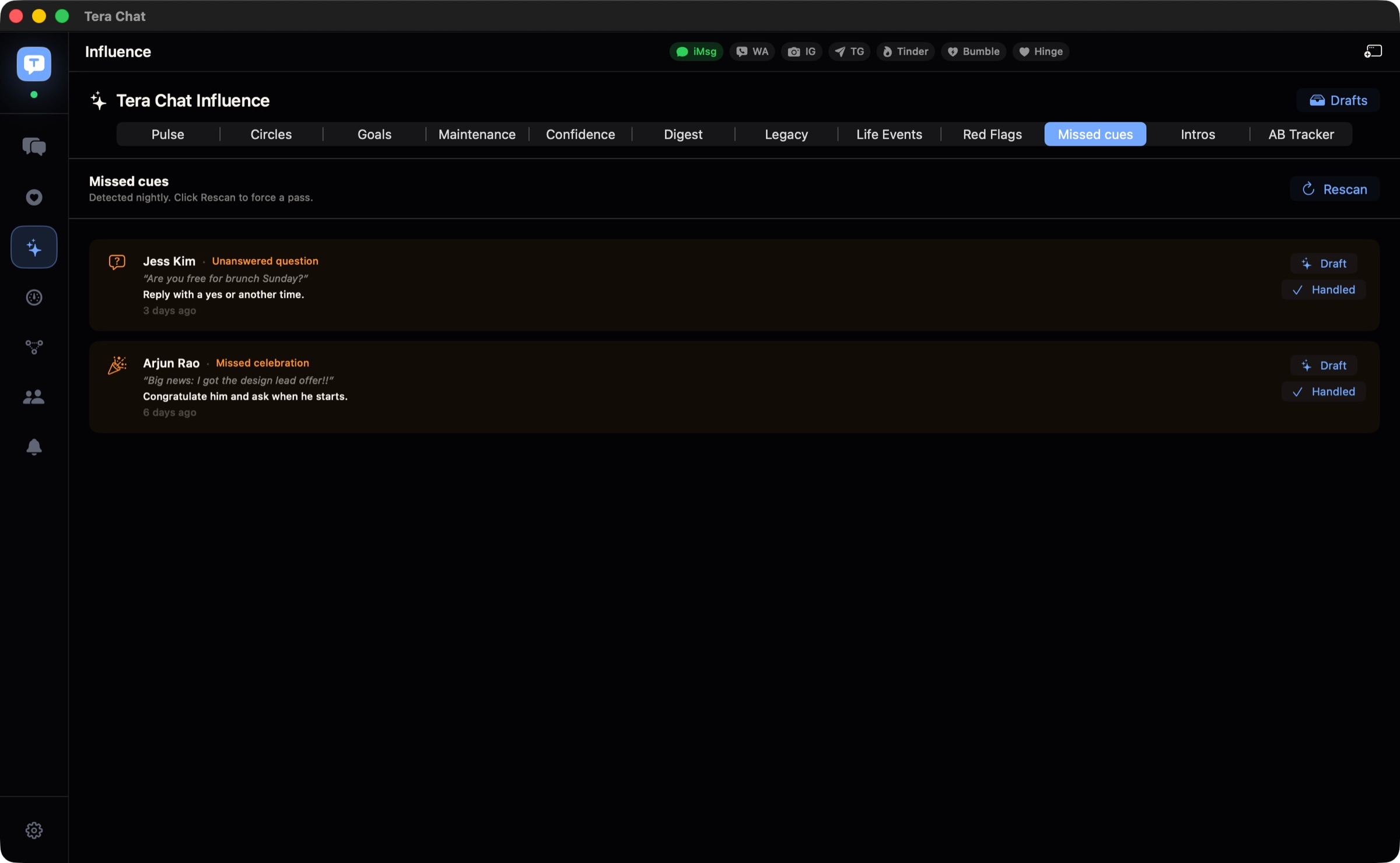
The limits: it runs only on Macs with Apple silicon and macOS 15 or later, it only knows what was said in the chats you connect, and AI can get a detail wrong, so treat it as a prompt to check, not a record. If you’re weighing whether to let any AI read your messages, our privacy checklist for AI and your messages covers the trade-offs.
Where’s the line between attentive and creepy?
Remembering details feels caring when it’s clearly about what the person chose to share with you. It feels creepy when it reveals you know more than they told you, or when it’s used to impress rather than to care.
Six rules that keep you on the right side:
- Only keep what they told you. Some tools now surface information people never shared with you: Mesh, for example, promises to show contacts’ “career moves, news mentions, and life updates” (Mesh). That can be useful for a professional network. With friends, bringing up something they never mentioned to you can feel like being watched.
- Use details to ask, not to perform. “How did the interview go?” is warm. “On 3 October you said you were nervous about the second round” sounds like a file.
- Match the detail to the closeness. Remembering a colleague’s daughter’s name is lovely; mentioning their health condition is not, unless they bring it up.
- Never raise sensitive details in a group. Something told one-to-one stays one-to-one.
- Keep only notes you’d be comfortable with them reading. If a line would hurt them, delete it.
- Protect the notes. They’re information about other people. Keep them in a locked device or account, and think twice before pasting them into random apps or websites.
If someone notices and asks, be honest: “I write things down because my memory is terrible and I care about this stuff.” That’s more honest, and kinder, than pretending you remember everything.
Make it a habit
You don’t need a perfect memory to be the friend who remembers. Capture three lines after a conversation, keep one note per person, try to recall before you check, and turn each detail into one good question. To build this into a wider routine for staying close to friends, see our guide to keeping in touch with friends as an adult, and for the dates that matter most, birthday reminders, including birthdays pulled from your chats.
Frequently asked questions
Is there an app to remember details about people?
Yes. The notes field in your phone's Contacts app works for most people. Personal CRMs such as Dex and Mesh add reminders and imports from email and other accounts, and Tera Chat on a Mac picks up details from your chats once AI is set up. The habit of noting and reviewing matters more than the app.
Is it creepy to keep notes about your friends?
Not if the notes are things they told you and you use them to ask better questions. It becomes creepy when notes include things they never shared with you, or when you use details to surprise or impress rather than to care.
How do I remember what people tell me in conversation?
Ask one follow-up question about the detail while you're talking, write a short note within a day, and before you next talk, try to recall it before checking your note.
Should I tell friends I keep notes about them?
If it comes up, be honest. Saying you write things down because you care and your memory is unreliable is usually better than pretending to remember everything.
Published . How we write and check our guides. Spotted something out of date? Email hello@terachat.co.