Dunbar's number and your friends: using the 5-15-50-150 circles
Dunbar's number says you can keep about 150 friends, in circles of 5, 15 and 50. What the research shows, what critics say, and how to use the circles in real life.
The short answer
- Dunbar's number is about 150 meaningful relationships, with smaller circles of about 5, 15 and 50 inside it; each circle is roughly three times the size of the one inside it.
- Robin Dunbar's 2025 review gives minimum contact rates to keep each circle stable: about weekly for the closest 5, monthly for the 15 and yearly for the 150.
- The exact number is disputed: a 2021 reanalysis found the statistical uncertainty is so wide that no single number can be derived, though the layered pattern shows up across many kinds of data.
- Used as a planning guide rather than a law, the circles tell you where to spend limited social time: about 40% of social effort typically goes to the closest five people.
Dunbar’s number is about 150: the number of meaningful relationships, friends and family included, that Oxford psychologist Robin Dunbar argues a person can maintain. Inside it sit smaller circles of about 5, 15 and 50 people, each roughly three times the size of the one inside it, with closeness and contact falling as you move outward. In a 2025 review, Dunbar gives the minimum contact each circle needs to stay stable: about once a week for the closest 5, once a month for the 15, and once a year for the 150.
This page explains where the numbers come from, what each circle means, the serious criticism of the idea, and a practical way to use the circles to decide who to keep in touch with and how often.
What is Dunbar’s number?
Dunbar’s number is an estimate of how many stable, meaningful relationships one person can keep at a time. Dunbar first derived it in the 1990s by extending a pattern from primates: species with a larger neocortex relative to the rest of the brain live in larger groups, and extending that line to human brain size predicts groups of about 150.
He then looked for that number in human data. A 2020 review collects personal network sizes measured in very different ways, from Christmas card lists (one study’s average was 153.5 people) to mobile phone calling networks and Facebook friends. Across those samples, average network size ranged from 78 to 250, with an overall mean of about 154.
The 150 isn’t everyone you know. In Dunbar’s terms, it’s the outer edge of meaningful relationships: people you know as individuals, with a shared history and some sense of obligation. Beyond it, relationships become more transactional and anonymous.
What are the 5, 15, 50 and 150 circles?
The circles are layers inside your network. They’re cumulative (the 15 includes the 5, the 50 includes the 15) and each is about three times the size of the one inside it. Dunbar’s 2025 review labels them like this (the names in brackets come from his earlier papers):
| Layer (cumulative) | Dunbar’s label | In practice | Minimum contact to stay stable |
|---|---|---|---|
| 1.5 | Intimate friends | Usually a partner or one very best friend | Not specified separately |
| 5 | Close friends (also called the support clique) | The people you’d turn to in a crisis | About weekly |
| 15 | Best friends (the sympathy group) | The people you count as close friends | About monthly |
| 50 | Good friends | For example, people you’d invite to a big birthday | Not given in the 2025 review |
| 150 | “Just friends” | Meaningful relationships: old colleagues, school friends, wider family | About yearly |
| 500 | Acquaintances | People you know, without much closeness | None |
| 1,500 | Familiar faces | People whose names you know | None |
| 5,000 | Known faces | Faces you’d recognize | None |
A few findings make the table more useful:
- Family counts. Dunbar reports that in today’s networks, family and friends each make up about half of every layer, and that people from large extended families tend to have fewer friends. Relatives take slots first.
- The inner circles are small in surveys too. In one of two UK surveys published in 2016, people reported an average of 4.1 people they’d rely on in a crisis and 13.6 close friends, close to the 5 and 15 the theory predicts.
- Effort is lopsided by design. About 40% of all social effort goes to the five closest people and another 20% to the next ten, so 60% of social time goes to just 15 people (Dunbar, 2020).
- The inner five are stable; the rest churn. The innermost circle changes by about one person every ten years, but up to 30% of people in the other layers move circles or drop out each year.
How often does each circle need contact?
Dunbar’s 2025 review states minimums: once a week for the 5, once a month for the 15 and once a year for the 150, and he stresses these are minimums, not averages. Below them, closeness starts to slip.
Three more details from his work matter for real life:
- The channel matters less than you’d think for the rhythm. Dunbar reports the same contact patterns in face-to-face meetings, phone calls, texting and social media posts.
- But face-to-face still matters for the friendship. In the 2016 paper he suggests social media may slow the decay of friendships, but probably can’t stop them dying without occasional face-to-face contact.
- Friendships fade fast; family doesn’t. Too little contact makes a friendship’s emotional closeness drop measurably within a few months, while it probably takes about three years of silence for someone from an inner circle to fall out of the 150 entirely. Relatives tolerate long gaps far better.
There’s also evidence that people feel the gap. In phone data Dunbar cites, when someone failed to call a contact at their usual rate, the next call to that person ran about 50% longer, as if to repair the relationship.
And because time is finite, adding people means others get less. A study of students moving from school to university or work, tracked through 18 months of phone records, found each person kept a stable “social signature”: as new people joined their network, others got fewer calls, so the overall shape stayed the same.
Is Dunbar’s number real? What the critics say
The exact figure of 150 is genuinely disputed. The layered shape of personal networks is better supported than the number itself.
The strongest challenge came in 2021, when Patrik Lindenfors, Andreas Wartel and Johan Lind at Stockholm University re-ran the primate analysis on different datasets with several statistical methods. Their estimates for human group size were 69 to 109 with one method and 16 to 42 with another, with 95% confidence intervals of 4 to 520 and 2 to 336. Their conclusion: with uncertainty that wide, naming any single number is futile.
Dunbar responded in The Conversation that the study used flawed statistical methods (he says the regression method it relied on gives 71, while the method he originally used gives 158) and ignored the body of direct evidence from human networks.
Our reading, for practical purposes:
- Don’t treat 150 as a hard limit. Individual networks vary widely; the 78 to 250 range in Dunbar’s own review shows that.
- Do take the shape seriously. Small inner circles, steeply falling contact as you move outward, and fast decay without contact appear in phone records, surveys, social media and Christmas card lists alike.
- Use the numbers as capacities, not targets. If you have 3 people in your core and 9 in the next layer, nothing is wrong. In a 2023 Pew Research Center survey, 53% of US adults said they had one to four close friends and 38% had five or more.
How to use the circles in practice
Map your own circles once, give each a minimum rhythm, and review every few months. It takes about 20 minutes and gives you a clear answer to “who should I message this week?”
- List the people you’d be sad to lose. Scroll your chats and photos from the last year or two.
- Choose your core. Up to about five people you’d call in a crisis, family included.
- Choose the next layer. Up to about ten more you’d want to hear big news from within a week or two.
- Sort the rest into “good friends” and “friends”. When unsure, pick the outer circle.
- Give each circle a minimum rhythm (table below).
- Re-sort every three to six months. With up to 30% churn a year outside the core, the list goes stale quickly.
| Circle | Minimum rhythm | Easy ways to meet it |
|---|---|---|
| Core (about 5) | Weekly | Voice notes, a standing call, sharing small daily things |
| Close (about 15) | Monthly | A specific check-in, a call, a plan with a date |
| Good friends (about 50) | Every 2–3 months (our suggestion; the 2025 review gives no figure) | A link with a personal note, congratulations, a group plan |
| Friends (about 150) | Yearly | Birthday messages, end-of-year catch-ups, reacting to big news |
If you’re over capacity in a layer (say, 25 people you feel you must contact monthly), that’s the sign to move some to the next layer out, not to try harder. The time-budget findings above suggest you can’t sustain it anyway.
You’ll also see a “5-25-150” split in personal-CRM templates. It’s a convenient variation, but it isn’t from Dunbar’s papers, which use 5, 15, 50 and 150. Either works as long as the inner circle stays small. Our guide to keeping in touch with friends as an adult turns these circles into a full weekly routine with a template, and how often should you text your friends covers texting rhythms in more detail.
Can an app track your circles for you?
Yes, if your friendships mostly happen over messages. A spreadsheet works, and personal CRMs such as Dex and Mesh let you tag contacts and set reminders (we compare them in personal CRMs for friends). Their data mostly comes from what you type in or from email, calendars and LinkedIn, and how much they can read from messaging apps varies a lot by tool.
Tera Chat, our Mac app, works from the conversations you already have in iMessage, WhatsApp, Telegram, Instagram and Tinder. Under Influence → Circles you can create circles, add contacts, or let it suggest circles; under Influence → Goals you set a target per circle (deepen, expand, revive or maintain). The contacts list shows each person’s tier, relationship health and when you last talked, and fading chats are flagged before they go cold.
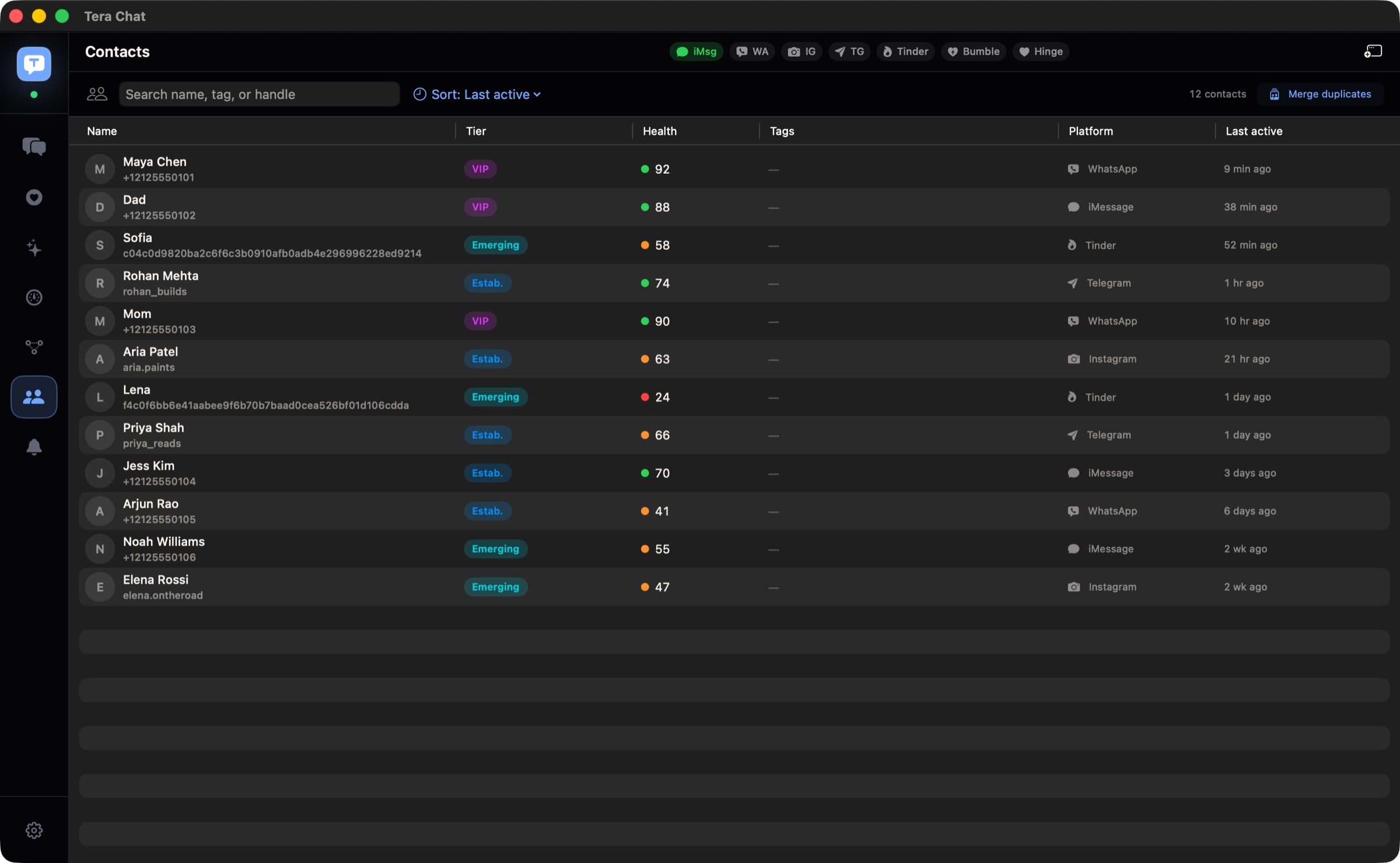
The honest limits: Tera Chat runs only on Macs with Apple silicon and macOS 15 or later, it doesn’t see Signal, Messenger, email, phone calls or time spent in person, and its circles are only as good as the sorting you do. The circles idea works just as well on paper.
The short version
Dunbar’s number is a rough capacity, not a rule: about 150 meaningful relationships, organized in circles of about 5 and 15 that need contact at least weekly and monthly to stay close, a circle of about 50 we’d touch every few months, and an outer 150 that needs about a yearly touch. The number itself is debated; the practical lesson isn’t. Protect the small inner circles, accept that the outer ones change, and give every circle a minimum rhythm before life fills the calendar. For the wider picture of how connected people actually are, see our friendship and loneliness statistics.
Frequently asked questions
What is Dunbar's number for friends?
About 150: the number of meaningful relationships, family included, that Robin Dunbar argues most people can keep. Inside it are roughly 5 closest people, 15 close friends and 50 good friends.
Has Dunbar's number been debunked?
It's contested rather than debunked. A 2021 reanalysis of the primate data found the uncertainty too large to name one number, and Dunbar disputes its methods. The layered structure of personal networks has been found in phone records, surveys and social media data.
Does social media let you keep more friends?
Dunbar's 2016 UK surveys suggest not much. Average Facebook friend counts were about 155 and 183, close to offline network sizes, and people in one of the surveys counted only about 28% of them as genuine friends.
Do family members count toward Dunbar's number?
Yes. Dunbar reports that in today's networks, family and friends each make up about half of every layer, and people from large extended families tend to have fewer friends.
What is the 5-25-150 rule?
It's a variation used in some personal-CRM templates for sorting contacts. It isn't from Dunbar's papers, which use layers of 5, 15, 50 and 150.
Published . How we write and check our guides. Spotted something out of date? Email hello@terachat.co.